

This is an important Assembly. Will we continue to undo the efforts to implement the 2010 Strategic Plan? Or will the PCA move in a broader direction? I don’t know. We should all pray together that God will continue to bless the PCA and enable her to grow in what she aspires to be: faithful to the Scriptures, true to the Reformed Faith, and obedient to the Great Commission.
View Image Here
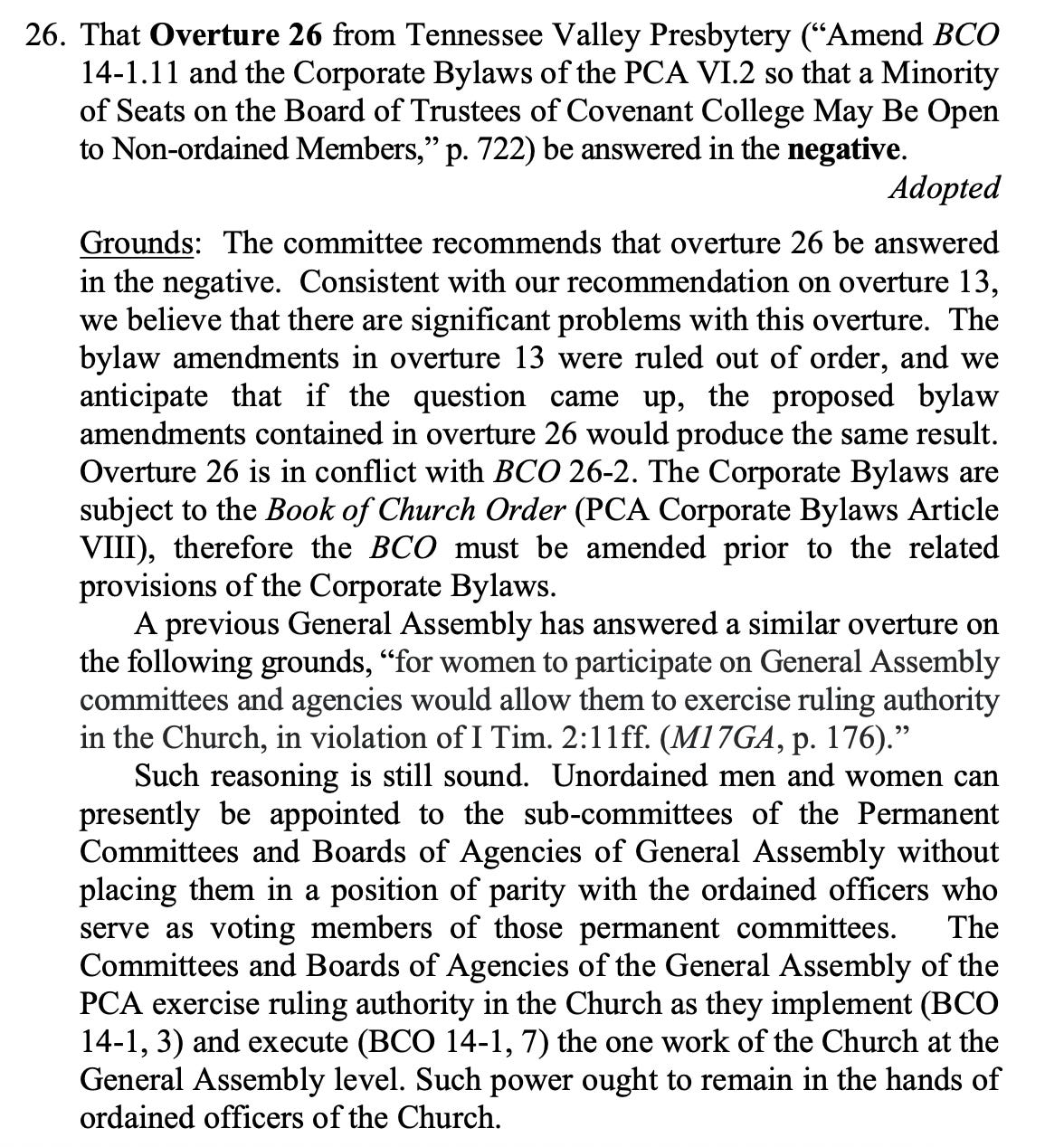
This was a decisive rejection of one of the three major emphases of the Strategic Plan: ‘More “Seats at the Table” for younger people, women, and ethnic leaders.’ The 2018 Assembly appealed to the 17th General Assembly to justify maintaining the historic position of the Church:
“for women to participate on General Assembly committees and agencies would allow them to exercise ruling authority in the Church, in violation of I Tim. 2:11ff.” (M17GA, p. 176).
Such reasoning is still sound. Unordained men and women can presently be appointed to the sub-committees of the Permanent Committees and Boards of Agencies of General Assembly without placing them in a position of parity with the ordained officers who serve as voting members of those permanent committees.
In this second part of my General Assembly Preview, I will survey the potential flashpoints in the Review of Presbytery Records report, some of the recommendations of the Administrative Committee, and a few other pending matters.
1. Review of Presbytery Records (RPR)
Review and Control (BCO 40) is what separates Presbyterians from all other forms of church government. We believe each church court possesses “the right to resolve questions of doctrine and discipline,” yet the narrower courts of the Church are subject to review and control of the broader courts (BCO 11-4).
In this way, “the whole is in the parts, and the parts are in the whole.” This ensures the PCA can maintain unity and integrity in the truth while at the same time fellowship together in purity and peace.
The matters arising out of RPR are some of the most significant at each Assembly. It is there the Assembly deliberates on matters such as,
- How to balance the rights of particular congregations with the prerogatives of a presbytery and session (e.g. may a presbytery take control of the assets of a congregation? must a congregation vote to elect its pastor or to dismiss its pastor?);
- How to ensure ministers have the freedom to preach the doctrine of the PCA (e.g. will a chaplain’s employer prevent him from ministering the truth? has a minister laboring in a “needful work” or “out of bounds” been properly installed to that work?);
- Define where the boundaries of orthodoxy will be established for the PCA (e.g. which theological errors may be held by ministers in the PCA? which theological errors may be practiced by ministers in the PCA?).2
This year’s RPR report contains recommendations that will likely produce lengthy debates on Wednesday morning. This debate is especially important because RPR not only preserves the rights of particular congregations, but also promotes our unity around the truth as we confess it together.
The chief flashpoints seem to be issues starting with the letter P this year: Preaching, Papists, Paedocommiunion, and Pictures.
A. Confessional Subscription: The Confession of Faith & Catechism contain the “system of doctrine taught in the Holy Scriptures”
The PCA does not require a minister to affirm “every statement and/or proposition” in the Westminster Standards (BCO 21-4), nonetheless the Standards are the official position of the PCA on the doctrines they set forth and declare what we believe the Bible to teach on those points of doctrine.
This is made clear in our constitution:
The Confession of Faith and the Larger and Shorter Catechisms of the Westminster Assembly, together with the formularies of government, discipline, and worship are accepted by the [PCA] as standard expositions of the teachings of Scripture in relation to both faith and practice (BCO 29-1).
The PCA’s view on “standard” teaching or “exposition” on what the Scripture says is found in the Westminster Standards as well as our BCO. The PCA does not accept a “Barthian” understanding of the word “containing” in our ordination vows.3 It is not that the Standards contain – somewhere – the system of doctrine taught in the Scriptures, but the Standards as a whole are a summary of that System.
As such, to express a difference with the Westminster Standards (or BCO), is to disagree with the PCA on what the Scripture teaches, says, or requires; to state a difference is to assert the PCA is wrong on what we confess the Scripture to teach. Accordingly, a presbytery must exercise great care when granting a man an exception for his wrong view. All disagreements with Westminster are – from the standpoint of the PCA – theological errors. But not every theological error is disqualifying.
It is a delicate balance to determine which theological errors may be held without harming the PCA’s unity and doctrinal system as a whole.
B. Preaching: Has God really forbidden women to preach?
The RPR Committee recommends finding an exception of substance with the minutes of Metropolitan New York Presbytery (MNY); MNY ruled a man may hold the view that women may preach, alleging such an errant view to be “not hostile to the system” or strike “at the vitals of religion.”
This is a curious judgment especially in light of a recent a case before the SJC in which MNY member TE Craig Higgins permitted a priestess to preach in a worship service.
Video Link Here
According to the SJC Report, the presbytery determined TE Higgins committed a censurable offense to permit a woman to preach. But at the same time, MNY granted a Teaching Elder an exception to hold the view that women may preach. There is a great amount of cognitive tension, since these two events occurred in the same year.
Understandably, RPR is recommending the Assembly enquire further as to this view. After all, to assert a woman may preach does not disagree merely with the PCA’s Standards, which summarize the teaching of Scripture. To permit a woman to preach is to disagree with the clear statements of the Scriptures themselves.
Paul grounds this prohibition in the created order, not culture:
I do not permit a woman to teach or to exercise authority over a man; rather, she is to remain quiet. For Adam was formed first, then Eve; and Adam was not deceived, but the woman was deceived and became a transgressor. Yet she will be saved through childbearing—if they continue in faith and love and holiness, with self-control (1 Tim. 2:12–15).
This is the universal practice of the Apostolic Church, and the contexts suggests women preaching is viewed by the Holy Spirit as a sign of disorder:
For God is not a God of confusion but of peace. As in all the churches of the saints, the women should keep silent in the churches. For they are not permitted to speak, but should be in submission, as the Law also says. If there is anything they desire to learn, let them ask their husbands at home. For it is shameful for a woman to speak in church (1 Cor. 14:33–35).
Subscribe to Free “Top 10 Stories” Email
Get the top 10 stories from The Aquila Report in your inbox every Tuesday morning.