

Christians must never underestimate the power and importance of the one body of Messianic signs. Why so? Because, as we learn from reading the Acts and the Epistles, the Spirit of God is pleased to use these Christ-centered signs—which display the evidential unity of the Bible—to draw God’s people to himself. They stand as a chorus of witnesses, loudly singing of the divine Prophet, Priest, Sacrifice, and King of heaven and earth. Because of them we see that the Old Testament confirms the New, even as the New illumines and fulfills the Old.
Sometimes you only get one shot. If so, you’d better make it count.
So it was with me one day several years back when my father-in-law and I rose from our chairs in a classroom at the local senior center. During the discussion time in a history lecture I had volunteered a brief comment about the Bible’s amazing historical memory: how the biblical narratives had actually spawned modern archeology, and how archeology in turn had consistently vindicated the biblical narratives. I was grateful for the opportunity to speak up, but thought that nothing further would come of it.
How wrong I was.
Immediately after the lecture an agitated man made his way straight for me. Before we could even exchange pleasantries, his question burst forth. “How can you possibly believe that the Bible is the Word of God?” It was not the first salvo in a tirade. He wanted an answer, and with some difficulty, was waiting for it.
How would you have replied? Seeing that your interrogator is upset, that he will stand for no nonsense, and that you doubtless have but one brief opportunity to deposit in his spirit your best single evidence for the divine inspiration and authority of the Bible, what would you give him?
Without premeditation—and I hope by the Spirit of the Lord—I gave him my best shot.
“Sir,” I replied, “there is one piece of evidence above all others that persuades me that the Bible is the Word of God. It’s what we call the unity of Scripture. As you may know, the Bible is actually a collection of books—sixty-six of them—written by over forty authors over the course of some 1,600 years. And yet for all this diversity, it really is one book. In all of its pages it tells one story, about one God, who sends one Redeemer into the world in order to bring together one beloved people for his eternal possession. The more you study the Bible, the more you see this amazing underlying unity. It is so pervasive, so intricate, so beautiful that no mere mortal could possibly have produced it. Rather, it simply has to be the product of a single divine mind, working through many different human authors. Above all else, it is this astonishing supernatural unity that persuades me that the Bible is the Word of God.”
And with that, he turned and walked away.
I reflect upon this experience with satisfaction, believing that by God’s grace I really did get off an excellent shot. My words, if quickened by the Spirit, were well able to give this troubled man a glimpse of one of the great supernatural marvels in the world today: what, in the paragraphs ahead, I will be referring to as “the biblical order.” In those paragraphs I want to examine this order in some depth. My fervent hope is that its intricate, beautiful, and majestic unity will not only strengthen your faith in the Word of God, but also give you renewed confidence to share that faith with others.
Orders, Orders Everywhere!
Let’s begin with a few introductory remarks about the common but surprisingly luminous phenomenon we call “order.”
The dictionary defines an order as an arrangement of differing objects, integrated into a unified system, according to a definite plan. This definition says it all. Order begins with a multiplicity—a collection of differing objects. But it requires something more: this multiplicity must be brought into a unified system by means of an arrangement of its parts. But even this is not all. Any old arrangement will not do. Rather, there can be no true unity and no true order unless the arrangement displays a rational plan and purpose. This is, of course, the spiritually significant characteristic of ordered systems: Their manifest patterns, complexity, beauty, and fruitful functioning all arouse within us an immediate and inescapable intuition—an intelligent person with a purpose and a plan has been on the scene. Order is, as it were, the very fingerprint of personal intelligence and power at work in the world.
Let me sum this up by introducing you to a special friend. His name is order/design/person-with-a-purpose. As you can see, he is a three-in-one friend, a little trinity. And this is precisely what makes him so significant and interesting: No matter where you look in all the world, there you will find him. You cannot not see him. Always and everywhere, you will find order, design, and a person-with-a purpose together. My friend is very stubborn about this. He will not allow you to see one of his faces apart from the other two.
The Bible knows my friend well, and it embraces him as a vital partner in the apologetic task. We see this in the fact that Scripture calls our attention to at least three different orders. One is the biblical order itself. But to appreciate that order most fully, we must first look at two others. As we do, let’s keep an eye out for our threefold friend.
The Natural Order
First, there is the natural order—the totality of all physical objects existing in space and time: the universe, the world. Opening our eyes upon it, we see immediately that order pervades the parts, and that order pervades the whole. It is present in the tiniest building blocks of nature—the atomic elements—which are composed of orderly arrangements of protons, neutrons, and electrons. It is present in the largest objects in nature: those vast and lovely aggregates of stars that we call galaxies and galactic clusters. And it is present in all the objects in between: crystals, clouds, columbines, conchs, crickets, cuckoos, crocodiles, and chemists. It is seen in the structure of things, the motions of things, the relationships of things, the complexity of things, and the beauty of things. Great or small, organic or inorganic, all the things that we call “things” are actually systems: orderly arrangements of component parts. Furthermore, these systems are always parts of bigger systems; and the bigger of bigger systems still, till we reach the biggest system of all: the cosmos itself.
And what is the spiritual significance of this all-pervasive order? In his letter to the Romans, the apostle Paul answers by telling us that order in nature is intended to press upon our minds inescapable intuitions of the existence and attributes of its divine Creator. Seeing order in nature, we cannot help but see design. Seeing design, we cannot help but see a person with a purpose. Self-evidently, this person is infinite, omnipresent, and divine (what finite person could create and sustain such a world?). And at least one of his purposes in nature is to show us that he is here, and that he is infinitely wise, powerful, and good (Romans 1:18-32).
The Moral Order
Next, there is the moral order. Unlike the natural order, this order is spiritual rather than physical. Nevertheless, it is no less real or consequential for our lives. Paul discusses this order as well, affirming that all men are innately aware of its several elements (Romans 2:1-16). These include the moral law, properly understood as a fixed code of moral absolutes, planted like solemn sentinels deep within all human hearts. Then there is moral obligation, an objective spiritual reality perceived by the spiritual faculty we call conscience. Pressing upon our conscience, moral obligation continually moves us to align ourselves with the moral law, or else to reconcile ourselves with it if and when we break it. Finally, there is the law of moral cause and effect. Our innate awareness of this law assures us that throughout history good will always triumph over evil; that what we sow we shall surely reap; and that righteousness will always bring reward, and evil retribution, if not in this life, then surely in the next.
Again, the moral order may be invisible, but it is no less real than physical nature itself. It is rather like the wind: Though we cannot see it, we can see and feel its effects. Every day we observe people relating to it: striving to honor it, warring against it, stumbling over it, longing to be reconciled to it, and more. Clearly, it is just as pervasive, complex, powerful, and beautiful as anything in the natural order. And like the natural order, it too manifests design and points to a person with a purpose. This person is clearly infinite, omnipresent, and divine (what finite person could fashion such an order and keep it functioning in the deepest recesses of every human heart?). Here, however, his purpose is to show us something else: that he is a holy sovereign, that he desires us to live well, and that he will reward us if we do, but judge us (or perhaps someone else in our place) if we do not.
The Need and Gift of a Revelatory Order
We find, then, that both the natural and moral orders bear witness to an infinite personal god. But what is their importance for the defense of biblical faith? Simply this: They teach us that the “unknown god” who stands behind nature and morality definitely likes to reveal himself to us in orders: in multiplicities of different objects that he skillfully draws into unified systems according to a rational purpose and plan. Systems are, as it were, his very signature, through which we can learn important things about him.
Note carefully, however, that the natural and moral orders only tell us so much. They tell us that a personal god exists, that he is powerful and wise, and that he is holy and sovereign. But they do not tell us the answers to any number of important religious and philosophical questions, questions that he himself has planted deep within our hearts. For example, does the infinite personal god of the natural and moral orders have a name? What are his attributes: What exactly is he like? How, when, and why did he create the universe, life, and man? Assuming that he is good, how did evil, suffering, and death enter and injure his world? Can anything be done about them? If so, what is his part, and what is ours? Truly, the list goes on. And that list includes what is perhaps the most urgent question of all: Where in the world can we find the answers?
Happily, in light of what we have discussed so far, a possible solution immediately springs to mind. In the natural and moral orders we see clearly that “the unknown god” is trying to rouse us to curiosity, to initiate within us a diligent search for a further revelation: a special revelation that will address all the religious and philosophical questions that burn in our hearts. But if that is so, would it not make sense for him to not only give us such a revelation, but also to cast it as a unified system: to fashion it into an intricate and sublimely beautiful “revelatory order”? To my mind that would make perfect sense, since in doing so he would be assuring seekers everywhere that the god who is disclosed in this revelatory order is “the unknown god” who created and maintains the natural and moral orders as well (Acts 17:26-28)!
Observant seekers of spiritual truth know that down through the centuries Christians have been contending for this very thing, asserting that in the Bible the unknown god has indeed given mankind just such a revelation. But how can we be sure of this? How can we know with certainty that the Bible really is the “revelatory order” for which the infinite personal god of the natural and moral orders has prepared the human heart?
It’s time now to find out.
The Multiplicity of the Bible
We cannot appreciate the unity of the Bible unless and until we see it against the backdrop of its very great multiplicity. Let us briefly consider it here.
The Bible contains a multiplicity of books—66 of them.
It was written over a multiplicity of years—about 1,600 of them—constituting more than 40 generations.
It was written in a multiplicity of places: on three separate continents (Asia, Africa, and Europe), in city and country, palace and prison, at home and abroad.
It was written by a multiplicity of authors—about 40 them. Note well that these authors were not just priests or theologians, but men from every walk of life. Among them there were kings, peasants, fishermen, poets, statesmen, a herdsman, a military general, a cup-bearer, a Gentile doctor, and even a tax collector. Furthermore, many of them were opposed by the spiritual leaders of their day, some were regarded as heretics, and some paid for their faith with their life. Clearly, the Bible is not the handiwork of any individual or of a closely knit religious cult.
Finally, it was written in a multiplicity of literary genres—at least eight of them. These include historical narrative, law, poetry, drama, proverb, prophecy, epistle, and apocalyptic vision.
If, then, the Bible really does display a striking multi-layered unity, the historical facts concerning its origin and literary character assure us that this unity is neither the product of one man, nor the collusion of many. But if it is not from man or men, from whom is it?
The Unity of the Bible
The unity of the Bible is indeed striking, multi-layered, and—I would argue—patently supernatural and divine. I will now try to make that case by showing that the Bible is actually one story, about one God, administering one plan of salvation, centered around one (divine) Person, who is attested by one body of (supernatural) signs, and worshiped by one people, according to one (eminently satisfying) worldview. Let’s take a moment to explore each fascinating element of this ambitious thesis.
One Story
Anyone who takes time to read the Bible in its entirety will soon discover that over the long haul it tells a single story. The story has a beginning, a middle, and an end. Distilled to its bare essence, it tells of the creation of the universe, life, and man; their profound wounding by the fall of Adam; and their glorious redemption through the divine person and all-sufficient work of the Son of God, Jesus Christ. This story has many characters: divine, angelic, and human. It has many themes: the love of the Father for the Son; the love of the Son for the Father; their common love for the universe, life, and man; the triumph of good over evil, truth over lies, humility over pride, faith and trust over doubt and despair, etc. It has a plot and many sub-plots. There is rising action, developing conflict, apparent defeat, and sudden, unexpected deliverance and victory. There is romance, mystery, comedy and tragedy. And—for everyone who plays his part in the story well—there is this above all: a happy ending.
In sum, the Bible displays an outstanding literary unity, a unity in which we discern the hand of a single divine Author. Note carefully, however, a fact of immense importance: the Author is at great pains to assure us that this story is not a mere story (i.e., a myth or a legend), but the kind of story we call “history.” It is not a fruit of man’s fancy, but a God-inspired narrative of actual historical events, recorded in words that are meant for our illumination, transformation, and eternal welfare.
Accordingly, this story is His Story and The Story: the one true God-given story from which all lesser stories—be they history or fiction—derive whatever truth, goodness, and beauty they may contain. This is why we all love stories, and why the biblical story over and again draws us to itself. For somewhere deep down, we all realize that history—whether cosmic or personal—is actually a story, and part and parcel of His Story. Said the wise Sam Gamgee, “What a tale we’ve been in, Mr. Frodo, haven’t we?” Yes, and we too know what Sam knows. But how we long to find the book in which the whole tale is told, so that we might discover our own role in it, find out how it ends, and (if at all possible) meet the Author as well. For folks who experience such spiritual yearnings, the literary unity of the Bible becomes a bright light shining in a dark world, inviting them to come, see, and understand (2 Peter 1:19).
About One God
In the one story, one character towers above all: God. And a great part of the drama of the story is that the more it unfolds, the more we learn about him: his names, titles, attributes, divine prerogatives, mighty works, and mysterious ways. Then, as the story nears its climax, something of extraordinary interest comes to light: the one God is actually a trinity of divine persons: Father, Son, and Holy Spirit. And learning this, we also learn that his works in history are most fully understood, not only in terms of God’s love for man, but also—and even primarily—in terms of the love of the Father and the Son, one for another (John 17:1-5).
And yet, despite all this unfolding trinitarian light, the message in every book of the Bible remains fundamentally the same: “Hear O Israel, the LORD is our God, the LORD is one, and there is no one else besides him (Deuteronomy 4:35; 6:4; Mark 12:28-34). In other words, the Bible—unlike the ancient pagan scriptures, with their complicated theogonies and vast pantheons—displays a consistent theological unity. And like its literary unity, this too comforts us, for intuitively we know that there is, and can be, only one God. Moreover, if we come to believe that the Bible is his book, we are hardly surprised to learn that part of his mission in history is to expose and dethrone every other so-called god, so that “. . . in that day there will be one LORD, and his name [Father, Son and Holy Spirit] the only name” (Zechariah 14:9; John 4:22-24; 2 Corinthians 10:5-6).
Administering One Plan of Salvation
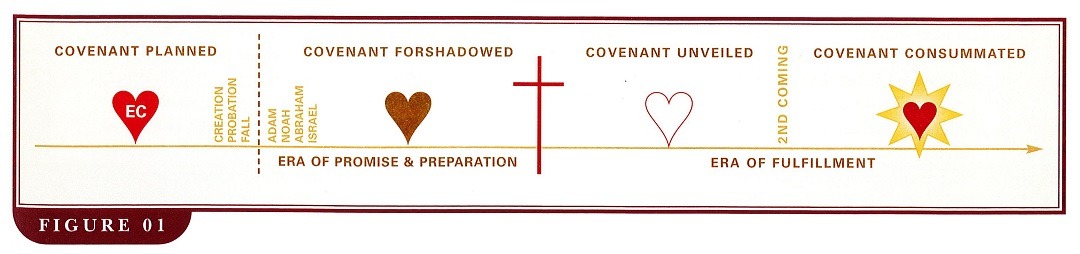
We have seen that, by and large, the Bible is a history book. But this is history of a very special kind: what the theologians refer to as salvation history. In other words, at its heart the biblical story is the story of God’s specifically redemptive acts: past, present and future. Reading this story—and especially the part we call the New Testament (NT)—it soon becomes apparent that God’s redemptive activity is unfolds according a plan. As a result, we soon realize that the Bible is best understood as a divinely inspired history of the administration of a single divine plan for the redemption of the universe, life, and man.
In order to catch a glimpse of the that plan, and to see how it binds the events of salvation history into a unity, let’s briskly work our way through the following time line.1 Image Link
The Eternal Covenant
This is the heart of salvation history. It is unveiled in the NT, where we finally learn that even before the creation of the world, God foreknew the fall of the universe, life, and man, and therefore devised a plan to redeem (i.e., rescue and restore) them. The writer to the Hebrews calls this plan “the eternal covenant” (Hebrews 13:20).2
A close study of the Bible’s most famous verse, John 3:16 (and related texts), reveals that this covenant involves five basic elements. In essence, there are two parties in the covenant: God (the divine party) and all who believe in the divine all-sufficient person and work of his Son (the human parties). There is a promise to all who freely enter the covenant through faith in Christ: the forgiveness of sins, the gift of Christ’s own righteousness, and eternal life in the Spirit with the triune God. There is a penalty for all who decline the invitation and disobey the command to enter the covenant: eternal punishment away from the life-giving presence of God. There is a special provision by which the sovereign Creator and Judge can welcome sinful man into the covenant without compromising his justice: God’s incarnate Son, living, dying, and rising again in behalf of all who trust in him. And there is a proviso, or requirement, with which fallen man must comply: repentance from his disordered life in sin and rebellion, and simple faith in the gift of God: the person and work of Christ. Again, it pleased God that for many millennia the several elements of his covenant would remain a “mystery”, a secret hidden away in him. Only in the fullness of time, at the appearing of his uniquely begotten Son in history, would they finally be revealed to every tribe, tongue, people, and nation.3
Creation, Probation, Fall
After creating a very good world, God was pleased put Adam and Eve to a test. This was paradigmatic. Henceforth, even to the end of the world, he would test all men—including his own incarnate Son.
1. This timeline reflects the traditional Reformed view of salvation history. Premillennial and dispensational interpreters would construct it somewhat differently. Nevertheless, all would agree in representing salvation history as the administration of a single Christ-centered plan in two basic eras: one of promise and preparation, and another of eternal fulfillment.
2. For an excellent brief discussion of the eternal covenant (of grace), see Louis Berkhoff, Systematic Theology (Eerdmans, Grand Rapids, MI, 1949), pp. 262-301.
3. Christ’s apostles were well aware that they lived in the era of fulfillment: the God-appointed season in which the mystery of Christ and the eternal covenant, formerly hidden, had now been brought to light. See Mark 4:11; Romans 16:25; 1 Corinthians 2:7; Galatians 4:4; Ephesians 1:9; 3:3; 9; Colossians 1:26; 2:2; 2 Timothy 1:10.
Subscribe to Free “Top 10 Stories” Email
Get the top 10 stories from The Aquila Report in your inbox every Tuesday morning.