

There is much that the PCA can learn from J. Gresham Machen. But the two lessons surveyed above—to prioritize the gospel of Christ for its own sake and to express clearly one’s confessional convictions on pressing matters within the church and the world—rise to the top. Machen believed the first of these tasks was (and is) vital to the existence of the church and the second was (and is) critical to the church’s long-term health. And he did so with firm resolve to submit his every engagement in the church and in the world to the law of love.
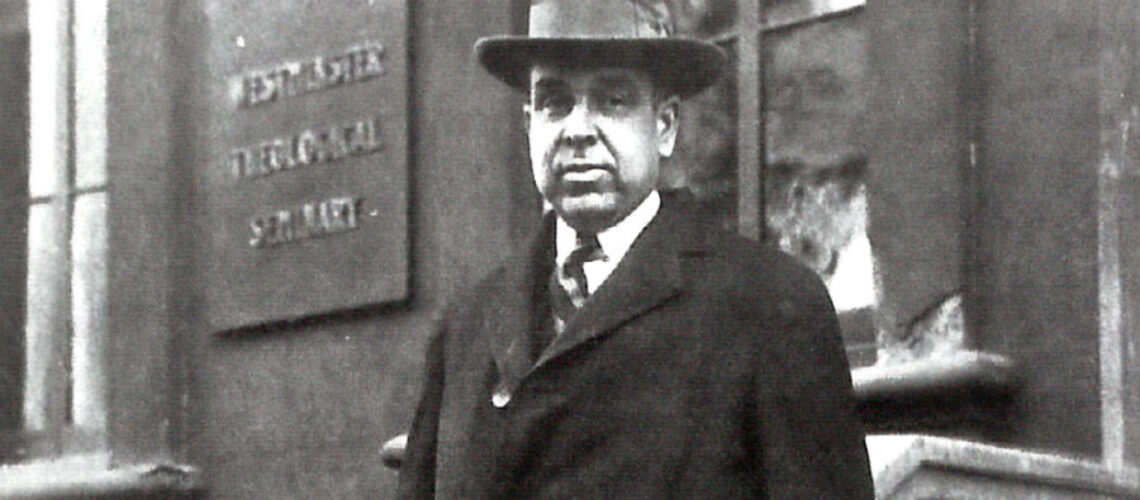
This year is the centennial anniversary of the release of J. Gresham Machen’s classic work, Christianity and Liberalism, a most opportune time for all in Reformed denominations, not just Machen’s own Orthodox Presbyterian Church (OPC), to reflect on the still relevant insights Dr. Machen has left us. My own denomination, the Presbyterian Church in America (PCA), celebrates its 50th anniversary this year. So PCA folks are providentially poised not only to give special praise to God for his grace to our expression of Christ’s kingdom, but also to assess how we can grow as a church that is “faithful to the Scriptures, true to the Reformed faith, and obedient to the great commission.”[1] With Machen’s famous book in hand, then, let us dare to ask: What can Machen teach the PCA that is useful in current days?
Asking this question requires that we first dig down to the varying roots of the OPC and the PCA. At the first General Assembly of the OPC in 1936, Machen described the thirty-four ministers and some five-thousand brave souls who had joined him as “members, at last, of a true Presbyterian Church.”[2] By claiming to represent a “true” Presbyterian church, Machen implicitly declared the northern Presbyterian Church in the U.S.A, infected as it then was with the rife spirit of modernism and liberal Protestantism, to be a false church. Over a decade earlier in Christianity and Liberalism, Machen had already been urging liberal ministers of the mainline denomination to withdraw from it in the interests of honesty, going so far as to suggest that the Unitarian Church is “just the kind of church that the liberal preacher desires—namely, a church without an authoritative Bible, without doctrinal requirements, and without a creed.”[3]
By contrast, the southern Presbyterian conservatives who founded the PCA nearly four decades after the birth of the OPC styled their new denomination a “continuing Presbyterian church loyal to Scripture and to the Reformed faith.”[4] That is, while the founders of the PCA observed that the southern Presbyterian Church in the United States (PCUS) was traveling a liberal course that made division inevitable, many of them envisioned the PCA to be “distinctly mainline in orientation.”[5] Like Machen and the OPC, they wanted the PCA to preserve confessional Presbyterianism in America, but to do so in a way that could also achieve “the larger goal of evangelizing and renewing American culture.”[6] Notably, the PCA has not always trumpeted this dimension of its origin story, and there have always been those within its ranks who have resisted the mainline desire for cultural influence in favor of a more thoroughly Reformed identity.[7] This fact helps to explain the tension and, at times, the struggle, over the PCA’s identity and direction over the half-century since its founding.[8]
The PCA’s ambivalent relationship with the broader culture also gives glimpse into the first lesson the PCA can learn from Machen: to be on guard, as a church, against using the Christian faith to achieve allegedly higher this-worldly goals. To be clear, this caution does not oppose Christian influence for cultural betterment per se. When Christ characterized his followers as “the salt of the earth” and “the light of the world,” he was hardly calling them to a separatistic or quasi-monastic lifestyle.[9] What Machen warned against was regarding the Christian gospel more as a means for worldly influence than a message directing sinners towards the realm of heaven through faith in Christ. The danger, Machen believed, lay in the fact that the former orientation inevitably replaces the glory of God in Christ with the rehabilitation of this “present evil age” (Gal. 1:4) as the chief end of man. As Machen puts it in Christianity and Liberalism,
[I]f one thing is plain it is that Christianity refuses to be regarded as a mere means to a higher end. Our Lord made that perfectly clear when He said, ‘If any man come to me, and hate not his father and mother . . . he cannot be my disciple’ (Lk. xiv. 26). Whatever else those stupendous words may mean, they certainly mean that the relationship to Christ takes precedence of all other relationships, even the holiest of relationships like those that exist between husband and wife and parent and child. Those other relationships exist for the sake of Christianity and not Christianity for the sake of them. Christianity will indeed accomplish many useful things in this world, but if it is accepted in order to accomplish those useful things it is not Christianity . . . Christianity will produce a healthy community; but if it is accepted in order to produce a healthy community, it is not Christianity.[10]
Notes
[1] “Presbyterian Church in America,” accessed February 2, 2023.
[2] J. Gresham Machen, “A True Presbyterian Church at Last,” Presbyterian Guardian (June 22, 1936): 110; emphasis added.
[3] J. Gresham Machen, Christianity and Liberalism, new ed. (Grand Rapids, MI: Eerdmans, 2009), 139–40.
[4] G. Aiken Taylor, “For a Continuing Church,” Presbyterian Journal (November 3, 1971): 7; emphasis added.
[5] Sean Michael Lucas, For a Continuing Church: The Roots of the Presbyterian Church in America (Phillipsburg, NJ: P&R, 2015), 3.
[6] Lucas, For a Continuing Church, 3.
[7] E.g., in his sermon at the first General Assembly of the PCA, Jack Williamson declared, “We have committed ourselves to the rebirth and continuation of a Presbyterian Church loyal to Scripture, the Reformed faith, and committed to the spiritual mission of the Church as Christ commanded in the Great Commission.” W. Jack Williamson, “To the Glory of God,” Presbyterian Journal (December 26, 1973), 11. It is odd that Lucas cites this sermon as evidence that those who formed the PCA were “profoundly interested in preserving American civilization through their efforts” (Lucas, For a Continuing Church, 2, cf. 313–14), since nowhere does Williamson call for this goal. Williamson did describe the visible church as “an institution in society,” but only to note that, like other institutions, the church possessed certain “distinguishing characteristics” or “marks,” namely, “the pure preaching of the Gospel; the Scriptural administration of the sacraments; and the exercise of discipline.” Williamson, “To the Glory of God,” 19.
[8] This struggle was recently evident in the contested decision of the 49th PCA General Assembly to withdraw from the National Association of Evangelicals. See Emily McFarlan Miller, “Presbyterian Church in America votes to leave National Association of Evangelicals,” Religion News Service, accessed February 4, 2023.
[9] See Craig Blomberg, Matthew,The New American Commentary 22 (Nashville: Broadman & Holman, 1992), 102.
[10] Machen, Christianity and Liberalism, 127–28.
This article was published in the Spring 2023 issue of the Reformed Forum Magazine. Subscribe now for free. If you provide a U.S. mailing address, we’ll mail complimentary copies of future issues to your door. You’ll also receive a link to download a PDF version of our current issue.
Subscribe to Free “Top 10 Stories” Email
Get the top 10 stories from The Aquila Report in your inbox every Tuesday morning.