

It was the approach of New England, which aspired to build a godly commonwealth, replete with established church and the power to expel or punish those that dissented, and to encourage a high view of worldly labors as service to God. That degenerated pretty quickly: New England theology “moved from high orthodoxy around 1650 to the rather massive Unitarian and Pelagian defection at the beginning of the nineteenth century,” as Roger Nicole puts it, and New England has been left as one of the most secular and atheistic (and generally miserable) regions in America today. Verily, American Reformer could be fairly called New England Reformer, as its approach is so much theirs, and most of the past resources they promote are by New Englanders.
In the previous installment I mentioned the influence of Carl Schmitt and Charles Haywood upon American Reformer (AR), and said that it is but one front in a larger movement of reaction against the Left. Granting that this does not mean that the content of everything AR publishes is mistaken, it invites further consideration as to AR’s aims, and as to what the likely consequences of its approach will be. Of interest also is AR’s affiliation with the secret fraternal organization Society for American Civic Renewal (SACR), discussed previously, and the for-profit initiative New Founding.
New Founding (NF) is a venture firm whose CEO, Nate Fischer, is also an AR co-founder and chairman and a member of SACR. NF managing director Josh Abbotoy is also AR’s executive director. Though AR, SACR, and NF are legally distinct entities, it is clear that there is some overlap among their members and leaders, and that they draw from many of the same sources. And some of those sources and their associated ideas are not good.
NF’s podcast has hosted Darryl Cooper, host of Martyr Made, for three of its 15 latest episodes. Cooper is conspicuous for questioning the ‘post-war consensus’ of how World War Two is normally understood. He insists that he is not a Nazi apologist, but posts things like this:

He tells people not to let anti-Semitic hatred consume them, then says things like this:
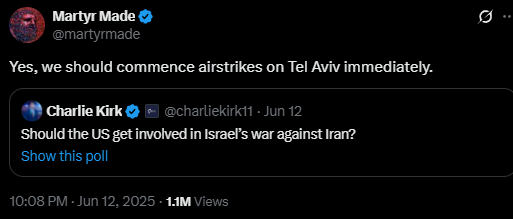
Here’s the thing about being a Christian: we don’t have to choose between competing evils, but can (and should) reject them all. Again, many of the people associated with NF are professing believers, and NF lists “church and ministry” as one of the five areas its network intends to influence, in addition to being a formal partner with AR. And yet NF’s podcast hosts people like Cooper.
Having looked through Cooper’s public statements, I do not hesitate to say that the man speaks out of both sides of his mouth as regularly as one’s ears hang on the sides of one’s head. Most for-profit entities would not host a podcast with such a man, and would promptly sever ties with him when they realized how wretched his opinions are. NF, by contrast, apparently thinks much of its base likes Cooper and that he has a worthy message.
A question. Is it really this hard to forego listening to and platforming people like Cooper? He is a liar, clearly, and rather debauched to boot.[1] The Substack post in which he tells people to not let hatred consume them is full of filth that is shameful to discuss, hence why I have not linked or quoted it directly. Amongst other things – including graphic Holocaust jokes and talk of women being crudely propositioned – he admits to making fun of a deaf friend for 20 years running, and is a proponent of the ‘they’re only jokes, don’t be so serious’ attitude about such things.[2] Tell me, how well does that attitude match Christ’s commands?
Note especially that bit about how evil speech defiles a person and consider how hard it will be to give an account for such speech at the Last Day. (And if you think people get grace and are built up by graphic Holocaust jokes or reminiscing about lurid sexual advances, your heart is crooked within you, and you ought to fear that it has not been regenerated by God’s Spirit.)
Does this throw a pall over all of AR’s contributors? Of course not. Are most of them aware of the mistaken associations of other people in the larger AR/NF/SACR network? Perhaps not. But one could wish that some of them would notice and mention to their compeers that hosting subtle Nazi apologists who insist they aren’t Nazi apologists is a bad idea and doesn’t help the cause of advancing “a vigorous Christian approach to the cultural challenges of our day,” as AR’s mission statement puts it. Nor does it do anything toward fulfilling our instruction to “give thought to do what is honorable in the sight of all” (Rom. 12:17): granting that a lot of people are going to criticize AR, et al. no matter what they do, it’s still not right to give them valid grounds upon which to do so.
But lay that aside and consider other of NF’s ideas and ventures. There is Ridge Runner, their real estate program to establish model communities in Tennessee and Kentucky. As a general rule, rural Southerners don’t much like it when rich foreign development companies[3] fell their forests and cover their fields with neighborhoods with HOAs, so it might be expected that Ridge Runner won’t be much appreciated by many of the locals. But of course one mustn’t let that trouble him when there is an America to be ‘newly founded’ and so much money to be made (the cheapest lots are $35k apiece, and they ascend steeply from there).
It’s that last part that is especially repulsive about NF. They represent a worldly version of Christianity that thinks excellence in industry and commerce and moneymaking is a virtue and pleasing to God. One of their podcast episodes is titled “Why are Christians Allergic to Ambition?” Another is called “Don’t Waste Your Life Building a Small Business—Build a Large One.” I trust I don’t need to belabor the point that implying that Christian small business owners are wasting their lives is rather inconsiderate and arrogant, or that material contentment is scripturally-commended (1 Tim. 6:6-8).
The fawning over rich men and the topics discussed raise some eyebrows, such things as “hidden Christian nihilism” and how “Christendom needs an economic engine.” That former one includes the belief that regarding one’s job as a means of provision for family rather than as something higher is nihilistic.[4] But scripture itself seems to regard provision as the essential element in work: “Let the thief no longer steal, but rather let him labor, doing honest work with his own hands, so that he may have something to share with anyone in need” (Eph. 4:28; comp. 1 Thess. 4:9-12; 2 Thess. 3:11-12).
Certainly, it does not vaunt entrepreneurs and financiers as many are wont to do. Indeed, the things it says of rich men are blood chilling, such things as that “it is easier for a camel to go through the eye of a needle than for a rich person to enter the kingdom of God” (Lk. 18:25), and “woe to you who are rich, for you have received your consolation” (6:24). And how praising worldly ambition comports with 1 Tim. 6:10 (“those who desire to be rich fall into temptation, into a snare, into many senseless and harmful desires that plunge people into ruin and destruction”), I cannot see. Nor does it jive with verse 5 of that chapter, which says that “imagining that godliness is a means of gain” is a mark of “people who are depraved in mind.”
Indeed, the worldly element is what is repulsive in American Reformer as well. It represents a worldly Christianity that is obsessed with politics and culture, influence and power, and which in seeking to gain the world runs a real risk of losing its soul (Mk. 8:36). It views everything, even the academy and the church, through the lens of temporal concerns of politics and culture, and of dominating them lest the Left do so.
Ironic, seeing as the tendency to make everything political is one of the irksome things about the Left whom they oppose, and about the contemporary life they disparage. Yet the AR crowd does it too, just in reverse, and in so doing forgets that Christ’s kingdom is not of this world (Jn. 18:36). There is with them no leaving “every plant that my heavenly Father has not planted” alone because “they are blind guides. And if the blind lead the blind, both will fall into a pit” (Matt. 15:13-14), but rather a determination to fight the Left at every turn, and a desperation to do so that leaves them scrambling for ideas in bad places.
This approach has been attempted before. It was the approach of New England, which aspired to build a godly commonwealth, replete with established church and the power to expel or punish those that dissented, and to encourage a high view of worldly labors as service to God. That degenerated pretty quickly: New England theology “moved from high orthodoxy around 1650 to the rather massive Unitarian and Pelagian defection at the beginning of the nineteenth century,” as Roger Nicole puts it,[5] and New England has been left as one of the most secular and atheistic (and generally miserable) regions in America today. Verily, American Reformer could be fairly called New England Reformer, as its approach is so much theirs, and most of the past resources they promote are by New Englanders. (And of course mistakenly thinking that New England’s ways are the essence of America is an eminently New England thing to do: “the spirit of America,” as Massachusetts’s license tags proudly put it.)
Why would it be any different today? Why would America as a whole succeed where New England failed, especially when any present reformers face so much more dissent? Why would a Christianity obsessed with worldly dominance be any more pleasant now than in medieval Christendom, when rival popes excommunicated each other and the papacy quarreled with kings and princes and stirred nations up to war against each other?
It wouldn’t. There is nothing new under the Sun, and in all places and ages those that make the faith worldly do so at the expense of depriving it of its spiritual vitality and purity. Even Augustine besmirched his legacy badly when, craving the end of the Donatist split, he defended state persecution. Our would-be reformers would do well to see that they are repeating the past errors of others.
And it is to be feared that there will be bad consequences to doing so. Already they are needlessly offending some of their brethren and, I have no doubt, unbelievers. (I would be embarrassed if many of my unbelieving acquaintances stumbled across many articles that appear at AR.) Their ‘reform’ work invites major questions as to just what that entails, especially when they say things like “if you would like to consult with American Reformer regarding a potential reform effort in your institution . . . please contact us at [email protected].” It would be interesting to know if any Presbyterian Church in America (PCA) entities have been the subject of inquiries to that line, and if so, who was involved in consulting about them. There are quite a few people associated with AR that wouldn’t occasion alarm on that point, but the thought that, say, someone who mused about America needing a Protestant Franco might have intimate details about the inner workings of some of our presbyteries or agencies doesn’t sit well. If only the PCA were putting together a study committee that could look into some of these things…
Tom Hervey is a member of Friendship Presbyterian Church in Laurens County, SC. The opinions expressed in this article are solely those of the author and do not of necessity reflect those of his church or its leadership or other members. He welcomes comments at the email address provided with his name. He is also author of Reflections on the Word: Essays in Protestant Scriptural Contemplation, and helped modernize Volume I of James Hervey’s classic dialogue on evangelical faith, Theron and Aspasio, available now at Monergism.
[1] In the Substack article I mention later in this paragraph, he liked a reader’s comment that said “Darryl I just want the revisionist, ‘Hitler was misunderstood’ stuff” and responded “Oh, it’s coming.” In the comments on his Substack post about appearing on New Founding’s podcast (here) he liked the first comment, which stated, amongst other things, that “the cartoonish narrative about how evil the Nazis were belongs to the communists.” But we are to believe he’s not a Nazi apologist.
[2] And, as I said regarding Charles Haywood in my previous article, if one is inclined to say that Cooper is just going a little overboard with being a provocateur (or edgy, or trolling people, or whatever the current lingo is), then I ask: that is mature, prudent, and helpful . . . how? I searched through quite a lot of his X feed to see if that bit about bombing Tel Aviv was satire. Either it wasn’t, or else he doesn’t feel the need to explain himself if that was what he intended.
[3] In traditional Southern understanding, all outsiders to a local community are ‘foreigners,’ irrespective of nationality; nativity is conceived along local rather than national lines.
[4] Between about the 6:00 and 8:00 marks of “Why are Christians Allergic to Ambition?”
[5] Arguably he is too generous, as many would say its faults were well under way before the 1800s, and would find even Jonathan Edwards wanting, or else the last sound generation before a downgrade.
Subscribe to Free “Top 10 Stories” Email
Get the top 10 stories from The Aquila Report in your inbox every Tuesday morning.